Daily · Article 02 · 4 min read
- Security
- Open source
Drupal fixes are available. Protect the installer and verify the live version
18 November advisories · published 19 November 02:43 JST
Summary
Drupal released 11.4.13, 11.3.22, and 10.6.22. Follow the installer-protection guidance and obtain evidence of application on the live site.
Key facts
Drupal, open-source software for managing website content and pages, has released its announced security fixes. The 18 November advisory SA-CORE-2026-017 (CVE-2026-132165) says an attacker can use the installer to attempt reinstallation under specific conditions, potentially leading to site takeover or server code execution. Fixed supported releases are 11.4.13, 11.3.22, and 10.6.22. The earlier advance notice now has actual release numbers and remediation instructions. Security advisory · Released package
The advisory describes exploitability but does not establish confirmed attacks against particular sites.
The accompanying SA-CORE-2026-018 (CVE-2026-132166) concerns a chain of code that requires a separate unsafe-deserialization vulnerability to be usable. It is not directly exploitable on its own. Both advisories point to the same fixed releases. Second advisory

1. Why a running site still has an installer
Drupal supplies install.php to set up a site initially. Reading a public page and creating the site’s initial configuration serve different purposes. Once installation is complete, the installer does not need to remain publicly accessible. The official guide recommends blocking access to /core/install.php after installation. Protecting the installer
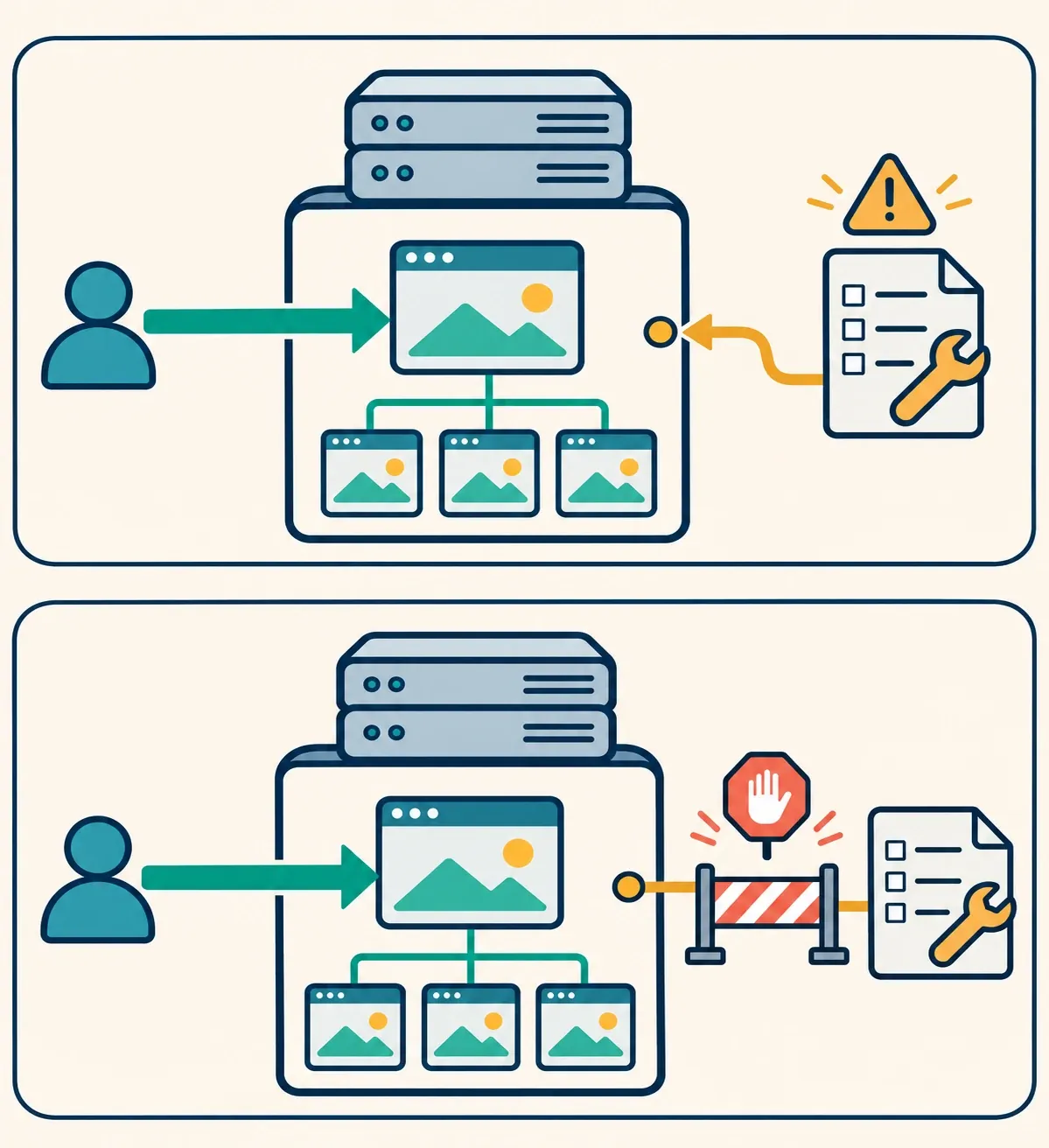
Imagine a library website where readers view events and staff edit announcements. An externally reachable installation route serves another purpose: under the advisory’s specific conditions, an attacker may use it to attempt reinstallation. The advisory does not disclose every attack input or condition, so merely finding the file does not establish that takeover has occurred.
The upper scene shows a public-page route and a separate installer route. The lower scene blocks only the installer route while public pages remain accessible. This is a recommended additional protection alongside the fixed release.
The cat asks Q&A
 The researcher
Why block an installation file after the site is already installed?
Pocket NotebookOrdinary visitors no longer need that function. The operator can follow the official guide, then check both the blocked response and normal page behavior.
2. Which version belongs to your branch
11.4 and 11.3 are separate maintenance branches. Identify your current branch before comparing the fixed release. A fictional site on 11.4.12, for example, should move to 11.4.13; this is not an observation of a real production site.
Drupal 11.2 and earlier, Drupal 10.5 and earlier, and Drupal 8 and 9 no longer receive security coverage. The three releases below are not interchangeable updates for every older installation: those sites need a plan to move to a supported branch. Coverage and remediation
| Current branch | Fixed release | Original release notes |
|---|---|---|
| Drupal 11.4.x | 11.4.13 | 11.4.13 release |
| Drupal 11.3.x | 11.3.22 | 11.3.22 release |
| Drupal 10.6.x | 10.6.22 | 10.6.22 release |
- Current branch
Drupal 11.4.x
- Fixed release
- 11.4.13
- Original release notes
- 11.4.13 release
- Current branch
Drupal 11.3.x
- Fixed release
- 11.3.22
- Original release notes
- 11.3.22 release
- Current branch
Drupal 10.6.x
- Fixed release
- 10.6.22
- Original release notes
- 10.6.22 release
The cat asks Q&A
- The researcher
If the test site is updated, is the production site finished too?
Pocket NotebookCheck the version on the site actually serving visitors. The test result, production deployment record, and application time together identify which target has been updated.
3. From available code to evidence on your site
After the project provides fixed code, a hosting provider or operator must apply it. The official update guide covers backups and a test environment, followed by checks of important pages and editing functions. A record that a backup file exists is also different from evidence that it can be restored. Update guide
| Stage and responsible party | Current state | Evidence to obtain next |
|---|---|---|
| Fix and release · Drupal project | Confirmed: two advisories and three supported-branch releases | Advisory and the matching release notes |
| Production availability · host or deployment operator | Unverified for each provider and site | Package availability for that site and deployment timing |
| Actual application · site operator | Unverified for each individual site | Live version, deployment/application time, and page/editing checks |
- Stage and responsible party
Fix and release · Drupal project
- Current state
- Confirmed: two advisories and three supported-branch releases
- Evidence to obtain next
- Advisory and the matching release notes
- Stage and responsible party
Production availability · host or deployment operator
- Current state
- Unverified for each provider and site
- Evidence to obtain next
- Package availability for that site and deployment timing
- Stage and responsible party
Actual application · site operator
- Current state
- Unverified for each individual site
- Evidence to obtain next
- Live version, deployment/application time, and page/editing checks
The cat asks Q&A
- The researcher
What else should I ask a provider that says the update is available?
Pocket NotebookAsk which version was applied to your production site, when, and whether its important functions work. Obtain records for the live target alongside package availability.
4. Keeping the installer protected
The official guide prefers a web-server rule blocking the installer. Removing the file is another option, but Composer, the package installation and update tool, can put it back. Check that external requests are actually refused rather than relying on a hidden menu. Protection and verification guide
The operator checks /core/install.php, the final destination of /install.php, and an additional path such as /core/install.php/foo, adjusted for the site’s subdirectory. The guide expects 403, meaning access is refused, or 404, meaning not found; a 200 response fails this blocking check. This verifies protection on a site the operator manages, without sending exploit input. The update script update.php is separate and should not be accidentally blocked by a broad rule.
Drupal Steward, a service that filters requests before they reach a site, protects some known installer attack paths. The advisory explicitly says it does not cover all possible exploits and recommends upgrading. Preventing the web server from writing to, or changing permissions on, settings.php also mitigates some paths; it is not comprehensive protection replacing the update. Protection limits
The cat asks Q&A
- The researcher
Should we keep the installer check after this update?
Pocket NotebookA later deployment can restore a file or setting, so repeat the check after deployment. Check normal pages and the database-update route too, to catch protection rules that block needed functions.
To close
Turn an available fix into an operational record
The new information is the three fixed supported releases and the installer-protection guidance. Recording the matching branch version, application time, and installer responses moves the work from waiting for an announcement to verifying the live result.
Sources
- Protection limitsdrupal.org
- 11.4.13 releasedrupal.org
- Second advisorydrupal.org
- Protection and verification guidedrupal.org
- 11.3.22 releasedrupal.org
- 10.6.22 releasedrupal.org
- Update guidedrupal.org