Daily · Article 02 · 4 min read
Qwen4-Max pricing depends on the region and what the model can reuse
16 November Alibaba launch · 17 November model documentation
Summary
Alibaba’s headline price applies to reused input in Singapore. A worked example shows how new input and output affect the bill.
Key facts
Alibaba, which operates online marketplaces and cloud services, released Qwen4-Max on 16 November. Its model guide, updated 17 November, says an API, the connection a program uses to call the model, accepts text, images and video and returns text. Singapore’s standard rates are $1.50 per million input tokens and $4.50 per million output tokens. The $0.075 in the announcement is the Singapore rate per million input tokens served from the automatic cache. Alibaba announcement · Model guide · Singapore prices

1. Writing a description from a product photo
Imagine a stationery shop describing a new notebook with a photo and a materials record. A staff member can choose the model in an app, upload the photo and edit the answer. The product listing program can send the photo and item details through the API and queue the returned text for review. This API returns text even when it receives a picture or video. The employee still checks materials and dimensions against the product record.
| Same task | Who uses it and how | Availability and conditions |
|---|---|---|
| Write descriptions one at a time | Staff member uses QwenStudio or QwenWork | Alibaba announcement lists both apps. Check model access and limits in your account |
| Connect the listing program | Developer calls qwen4-max through Model Studio | Check region, workspace access and API prices in the model guide |
- Same task
Write descriptions one at a time
- Who uses it and how
- Staff member uses QwenStudio or QwenWork
- Availability and conditions
- Alibaba announcement lists both apps. Check model access and limits in your account
- Same task
Connect the listing program
- Who uses it and how
- Developer calls qwen4-max through Model Studio
- Availability and conditions
- Check region, workspace access and API prices in the model guide
The cat asks Q&A
 The researcher
Can I use it on the same terms in my app if there is an API price?
Pocket NotebookCheck whether your app account lets you select the model. The API price applies when a program calls the model separately.
2. Why the beginning of a request can be reused
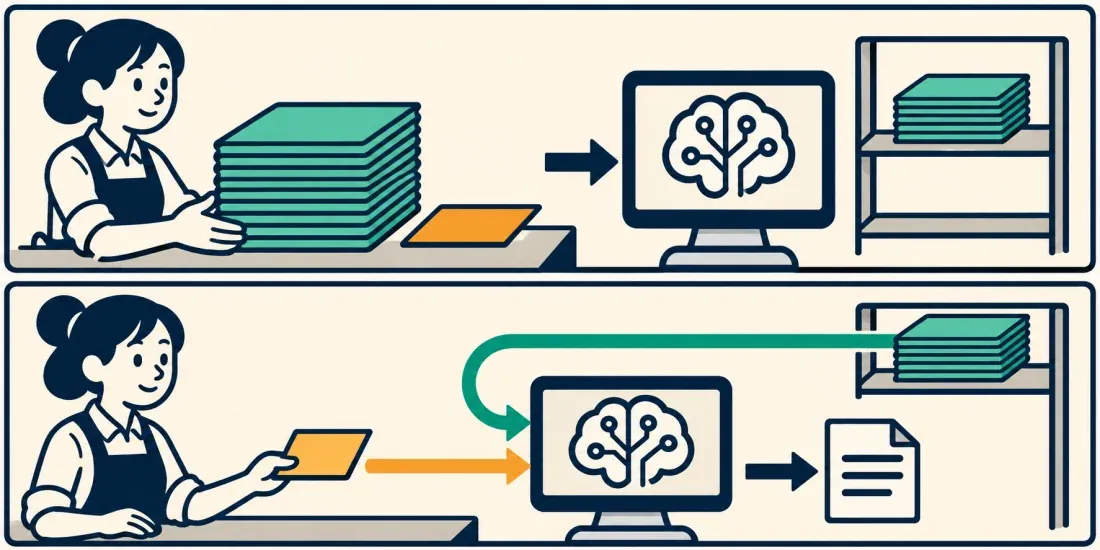
Tokens are small units the model counts when processing input. Suppose the shop starts each request with the same style and review instructions. The server, the cloud computer handling the request, can keep the work it did on that shared beginning and reuse it when the same prefix arrives. Both requests still include the instructions. This is a cache. A shared prefix needs at least 1,024 tokens to qualify for automatic reuse, and a cache hit is not guaranteed. Cache documentation
The cat asks Q&A
- The researcher
Will I pay the same rate if I change the style instructions?
Pocket NotebookReuse depends on how much of the beginning still matches. Check the request’s usage record to see how much input was served from the cache.
3. A worked example at Singapore rates
Suppose 100,000 input tokens consist of 80,000 shared and 20,000 new tokens, with another 10,000 billable output tokens. This estimates the charge for the second request alone. Billable output can include reasoning tokens as well as the answer. All prices are in US dollars. It uses standard Singapore rates and omits free quota, explicit cache creation, tools and tax. Singapore pricing
| Same input and output for one request | Input charge | Output charge | Total |
|---|---|---|---|
| No cache hit | 100,000 ÷ 1,000,000 × $1.50 = $0.150 | 10,000 ÷ 1,000,000 × $4.50 = $0.045 | $0.195 |
| Cache hits on the first 80,000 tokens | 80,000 ÷ 1,000,000 × $0.075 + 20,000 ÷ 1,000,000 × $1.50 = $0.036 | $0.045 | $0.081 |
- Same input and output for one request
No cache hit
- Input charge
- 100,000 ÷ 1,000,000 × $1.50 = $0.150
- Output charge
- 10,000 ÷ 1,000,000 × $4.50 = $0.045
- Total
- $0.195
- Same input and output for one request
Cache hits on the first 80,000 tokens
- Input charge
- 80,000 ÷ 1,000,000 × $0.075 + 20,000 ÷ 1,000,000 × $1.50 = $0.036
- Output charge
- $0.045
- Total
- $0.081
The cat asks Q&A
- The researcher
Is the whole request one twentieth of the usual price?
Pocket NotebookThat ratio applies to reused input only. New input and output still cost the usual amount, so the difference for this request is $0.114.
4. Region and the actual bill
A region is a cloud service location that has its own connection details and operating conditions. The 17 November guide lists several regions. Here are two examples of their standard rates. Check the region you connect to and the access in your workspace even when the model name matches. Regional model guide
| API connection region and published scope | Input per million tokens | Output per million tokens | Source |
|---|---|---|---|
| Singapore · International | $1.50 | $4.50 | Model guide · Singapore console |
| Tokyo · Global | $1.413 | $4.24 | Model guide |
- API connection region and published scope
Singapore · International
- Input per million tokens
- $1.50
- Output per million tokens
- $4.50
- Source
- Model guide · Singapore console
- API connection region and published scope
Tokyo · Global
- Input per million tokens
- $1.413
- Output per million tokens
- $4.24
- Source
- Model guide
The cat asks Q&A
- The researcher
Can my estimate use Tokyo’s rates and the Singapore cache price?
Pocket NotebookUse the rates from the region your request actually uses. A small trial lets you compare input, cached input and output with the bill.
To close
What to check before automating repeated work
If you answer several questions about the same document, check how much input your actual workload reuses. If you are editing a few reports by hand, start with the model choices and limits in the app you use.
Sources
- Alibaba Qwen4-Max launchalibabacloud.com
- Alibaba Cloud Model Studio model guidealibabacloud.com
- Model Studio Singapore pricingmodelstudio.console.alibabacloud.com
- Alibaba Cloud cache documentationalibabacloud.com