
Loading Park Labs...
Loading Park Labs...
LAB NOTE No.0212026.03.26Success
ReBrick AI is where it all started. In December 2025 I entered it in "Vibe Code with Gemini 3 Pro in AI Studio", a hackathon Google DeepMind ran on Kaggle, and after three months of judging it made the Top 50 out of 4,097 teams.
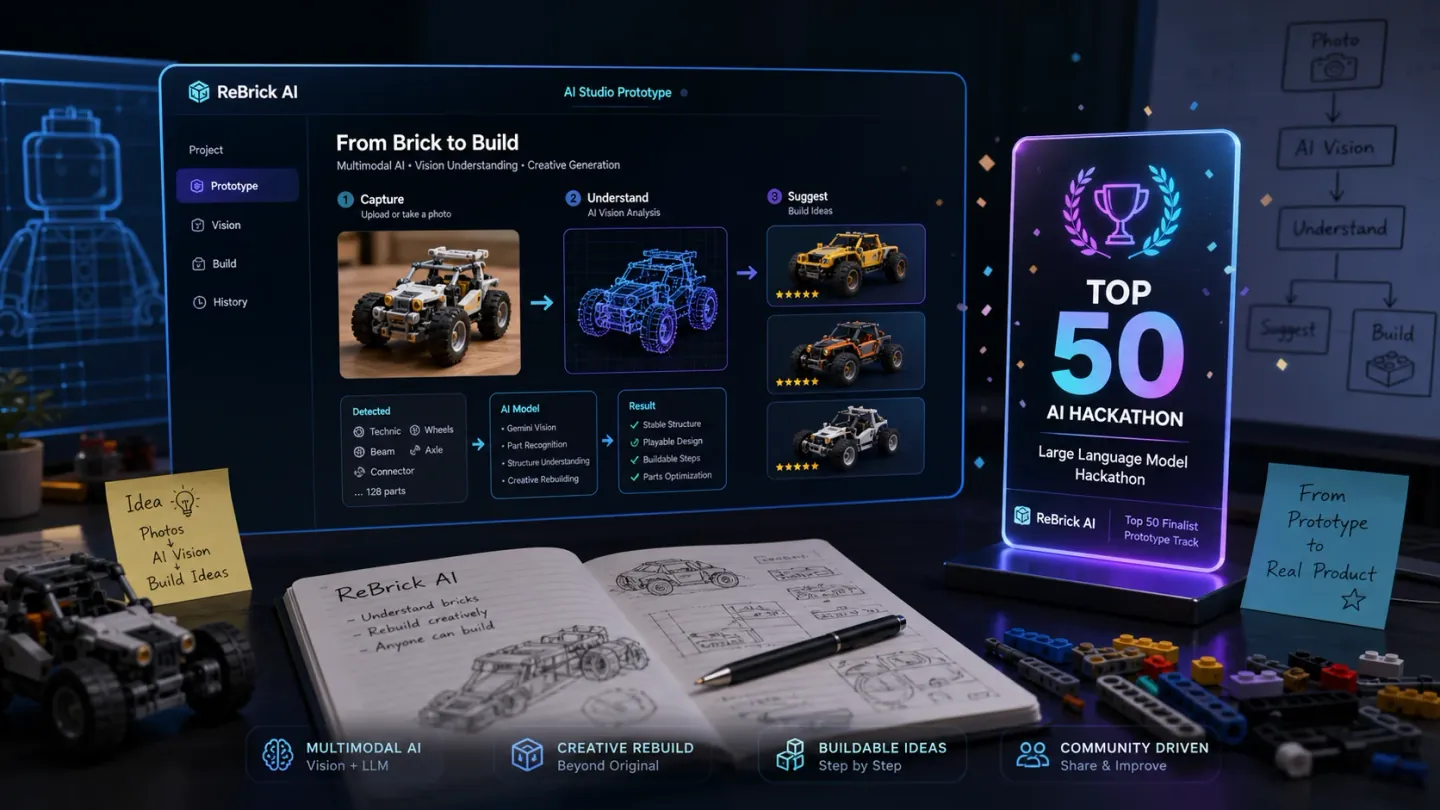
Table 1
| Item | Kaggle hackathon | Google Cloud hackathon |
|---|---|---|
| Contest | Vibe Code with Gemini 3 Pro in AI Studio (Google DeepMind) | 4th Agentic AI Hackathon with Google Cloud (Zenn) |
| When | December 5-12, 2025 | Finals on March 19, 2026 |
| Entries | 4,097 teams | 195 submitted projects (official Zenn page, checked October 22, 2026) |
| My entry | ReBrick AI · AI Studio prototype | BrickQuest · full-stack service |
| Result | Top 50 | Excellence Award (優秀賞) among the 10 finalists |
| Prize | $10,000 in Gemini API credits | ¥250,000 |
| Judging | Impact 40%, Technical Depth 30%, Creativity 20%, Presentation 10% | 5-minute pitch in Japanese plus 2 minutes of Q&A |
The contest ran for exactly one week, December 5-12, 2025. The task: build an app in AI Studio with Gemini 3 Pro that solves a real problem.
4,097 teams entered in that week. Google itself called it "one of the largest hackathons we have ever hosted." Judging took three months and involved 30 Googlers from engineering, product, DevRel, marketing, design and research.
The result: Top 50. That's the top 1.2% of 4,097 teams, and the prize was $10,000 in Gemini API credits.
Honestly, I didn't expect to get picked out of more than four thousand teams. I think I got lucky.
The entry is written up in my Kaggle Writeup, and you can see it running in the demo video (YouTube) and the live demo (AI Studio).
My entry was ReBrick AI, which is actually where BrickQuest came from. You take a photo of the LEGO bricks scattered around your home, and it tells you what you can build with the parts you have.
%% What ReBrick AI does · as entered on Kaggle
flowchart TD
  A["Photograph your scattered LEGO bricks"] --> B["Gemini 3 Pro Vision identifies color, size and type"]
  B --> C["Suggests models you can build with your parts"]
C --> D["3D step-by-step build guide · Story Mode"]I built ReBrick AI with AI Studio's Vibe Coding. The prototype showed me the idea had legs, and for the Google Cloud hackathon I built it myself as a full-stack app with Next.js, Three.js and Cloud Functions. That became BrickQuest. Same idea, completely different implementation.
A week earlier, on March 19, BrickQuest won an Excellence Award at the finals of the 4th Agentic AI Hackathon with Google Cloud (award note). So one idea was recognized in two contests.
What can I build with the LEGO lying around at home? I entered that question once as an AI Studio prototype and once as a full-stack service, and both contests took it seriously. I think the idea itself resonated. Every household with kids has the same problem.
The judging was quite different, as the table shows. Kaggle scored each criterion by weight, while Google Cloud judged the final pitch and Q&A. Still, both were asking whether the thing solves a real problem.
One part of the Kaggle results announcement stuck with me. Google summed up what the winning entries had in common: utility that removes real friction, agentic workflows where the AI reasons through multiple steps on its own, and native multimodality that works directly with images, video and audio, not just text.
ReBrick AI didn't hit all three. But real problem solving and the multimodal part, recognizing bricks from a photo, did line up.
With $10,000 in Gemini API credits, I can put them toward BrickQuest. Improving brick recognition takes a lot of API calls, and now I can experiment without worrying about the cost.
I'm a bit more convinced that this idea should become a real service. Two contests gave it a look. Time to actually build it.